
why writers don't write
on why we often don't start when we know it could change everything

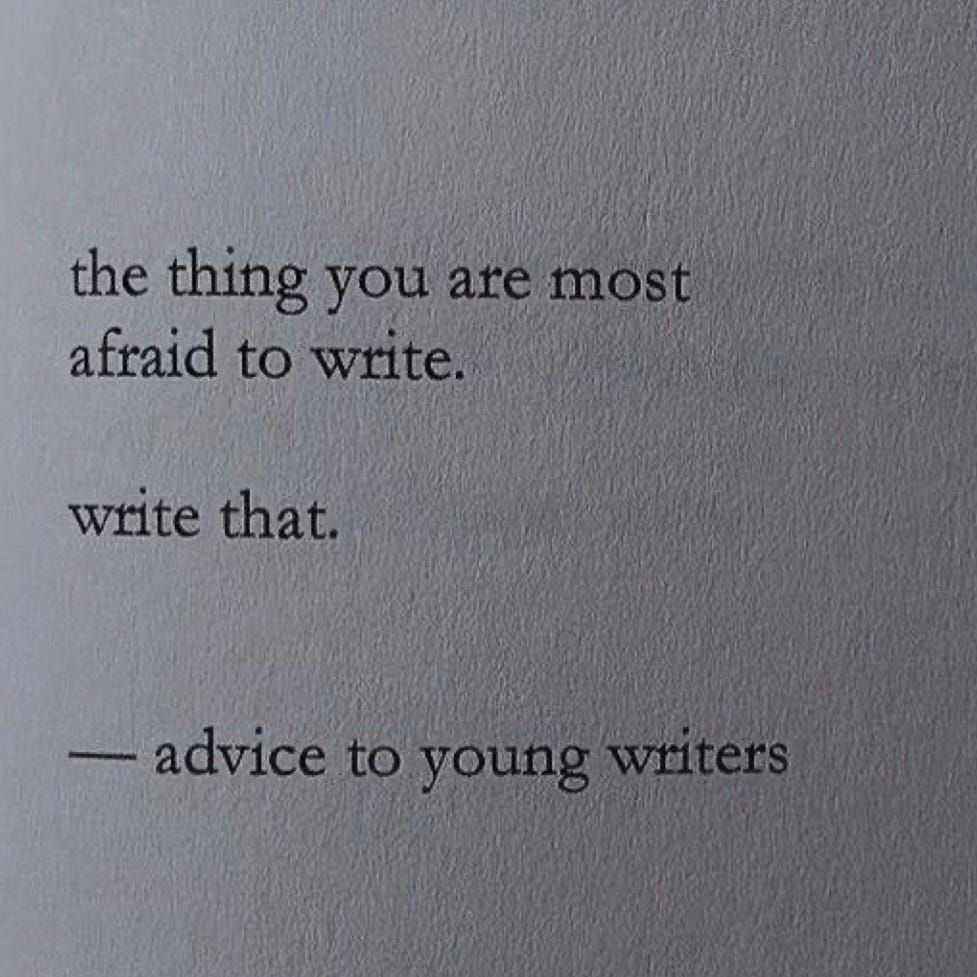
Over the last couple of years, if you’ve asked me what I’m passionate about, what I wish to accomplish one day, I will most likely have told you that I want to write a book. Before I die, I want to have written and published a book. I want to write.
Seems straightforward enough, right? Bit morbid, sure, but this definitely sounds like someone who knows what they want. Certainly, then, if this is so clear to me, if I’m so passionate, so sure - then this must be something I’m working towards, right? You don’t write a book overnight, or accidentally; this is not something that just happens.
But I don’t write.
In fact, at this very moment, it’s one of the first times in years that I have sat down, laptop open, blank page, with nothing else than the pure intention of writing. And I know that I’m not the only one who struggles with this — wanting something so badly, yet feeling absolutely paralysed at the thought of doing something about it. Of actively going after what you want.
I discovered my passion for reading and writing as a young girl. Painfully shy, yet hyperactive and accidentally disruptive, I fabricated my reading logs week after week. Caught in a lie, because there was simply no way I’d been reading the same five-page Mr. Men book for twenty minutes, three days in a row, I was taken to what I now call reading rehab, where a teacher suggested I try reading A Series of Unfortunate Events by Lemony Snicket. No more than a couple of weeks later, I’d bump into her on the school playground, nose buried in one of the latter books in the thirteen-volume series.
She’d created a monster.
I don’t think she’d imagined she’d have to ask me to not read and walk a few weeks later.
Soon after, I began to write.
I’d purposefully rush through my IT assignments, so I could reunite with my best friend at the time, the blank canvas of a Microsoft Word document. I’d write self-insert short stories, dreaming up adventures that echoed those of the main characters in my current read. I committed so much plagiarism — I’d get so excited about whatever I just read that I’d sit down and rewrite the story with one or two small minor adjustments.
But it was simple, and easy, and innocent, in a way that only occurs at a certain age. At an age where, if we wanted to do something, and we had the ability to do it, we just did it.
Because why would we not? Isn’t it incredibly silly to know what you want to do most deeply and truthfully, to have the privilege to do it, to be literally able to start right now — to open your laptop, the Notes on your phone, to grab a pen and paper, and to still not do it?
I try not to be too harsh on myself. Back then, my attention span hadn’t yet been cannibalised by social media; my time hadn’t been absorbed by work, relationships, and responsibilities. So time goes on, life happens, and somewhere between twenty-two and twenty-three you realise you’ve spent the last four years trying to return to that purity and clarity you once held at ten.
The thing is, when you feel so strongly about something, you may think you’ve forgotten or moved on, but I don’t think it ever truly leaves you. You can get distracted, you lose focus. But it simmers until it bubbles, it stings and itches, hurts, and outright annoys you to realise you’ve strayed so far from what you used to hold so close.
I remember moving across the world for university, once again a blank slate for the first time in eighteen years. I took courses in Psychology. I never once did a writing course. Never involved or indulged myself in anything creative. And yet I felt disappointed and frustrated — like I wasn’t being seen for who I truly am — when no one thought of me as the girl who likes to write… and that’s my thing!
But no, it’s not. And it was a harsh awakening to realise that, no matter how badly I wished I was writing and how much I wanted to write, how could I possibly claim writing was my thing when I hadn’t written in more than five years? The cognitive dissonance was humbling.
Frustrated, and on a mission to re-find myself after graduating from university, I signed up for a free Writing Workshop in an Amsterdam public library. Unfortunately hungover on a Saturday morning, but under no circumstances missing the opportunity, I showed up just on time and shuffled onto one of the last remaining spots all the way at the back.
We discussed the exact topic of this piece. The Courage to Write. I jotted down prompts and techniques. We emphasised the practice of freewriting and the difficulty of getting into the habit of writing.
That the hardest part, you guessed it, is getting started.
I learned a new word that morning. ‘Metawriting.’ To write about writing. A man had raised his hand and expressed his frustration to the instructor, that he’d found himself in a loop, where every time he’d attempt to sit down and write, he’d inevitably end up writing about writing. How much he was doing it, why he was or wasn’t doing it, and how he was actually going to start this time. And he’d get stuck in a vicious cycle.
I realised I’d been doing the exact same thing. She advised him, and unknowingly, also me, to steer away from prompts about writing if he had a tendency to metawrite, and to shift his attention elsewhere. And I get it — it’s not necessarily a productive route to go down, especially when coming from a place of guilt, of self-deprecation. Yet here I am, writing about writing, ironically enough, and actually getting somewhere this time. Because this time I have something to say.
Although now I write about myself, self-indulgent- and apologetically, I don’t think, in fact, I’d go as far as say that I know that I’m not the only one. This time, I think I’ve managed to break through the cycle of metawriting because I write not just to and for myself, but for other writers who don’t write. For actors who don’t act, and singers who don’t sing. There is room for all of us. And there is no perfect way to start.
Even if that means writing about why you’re not writing, until you actually write something.
Because now, I certainly would not call myself a writer. But I also can no longer say that I don’t write.
Nicole Woodman does it again. I loved every sentence. I FELT every sentence deep to my core!!!! Thank you for shining light on this, and for inspiring me to do the same!!!! I also used to write 20 page stories when I was like 7 😭 I didn’t care. I think it’s the perfectionism that comes with being this age. Like everything we do has to be monetized, or have potential to become a professional path. It’s okay to also just have hobbies!!! Love you Nikki.
Nicole we have such a similar perspective on writing and reading. I loved seeing myself reflected on this post. I know this is might come off as pushy but I recommend you to check out my (very new) bookshelf seris I think you might connect with it as I connected with this piece.